
Why We Feed Our Dogs a Species-Appropriate Raw Food Diet
“Species-appropriate nutrition is the single most important aspect and the greatest influencing factor upon an animal’s health.” – Dr. Sarah Reagan
First of all, let me begin by saying that if you are a kibble-feeding pet owner, we’ve been right where you are! As you will read, our decision to raw feed was well-thought-out and researched, and based on the immediate health needs of our new pup at the time.
For the health and long life of your precious pets, we hope you too will give raw feeding serious consideration as the first step to a healthier pet. We know first-hand it can seem intimidating and overwhelming. If you commit to it, we promise to walk you through every step of the way!
Our Story
When our first English Shepherd Eóin was young, he had a very sensitive digestive system- constipation, loose stool, poor appetite, itchy skin.* Talking to our veterinarian, dog friends/breeders, and searching the internet for answers revealed that the ingredients in the puppy kibble could be the culprits.
At first, we switched to a “holistic” brand without grains or eggs, which helped somewhat. I had previously heard of raw feeding, which included meat and vegetables along with supplements. It seemed time-consuming and complicated. A friend told me about the more simple prey model-style Species Appropriate Raw Food (SARF) diet.
Lots of research followed. It all made perfect sense, but we weren’t quite ready to take the leap. However, when the toxic commercial pet food scare swept the nation in 2007, we knew it was time. Eóin was 5 months old.
Immediately there was a huge change in him. The itchy skin disappeared; he was eager to eat for the first time, with smaller, less frequent stools with no odor or flies (a huge plus by itself!), beautiful gleaming white teeth, and a glossy coat. Maintaining his weight was easy. We also stopped dosing him (and the cat) with toxic flea products. The fleas left in search of the ‘friendlier’ realms of an unbalanced host.
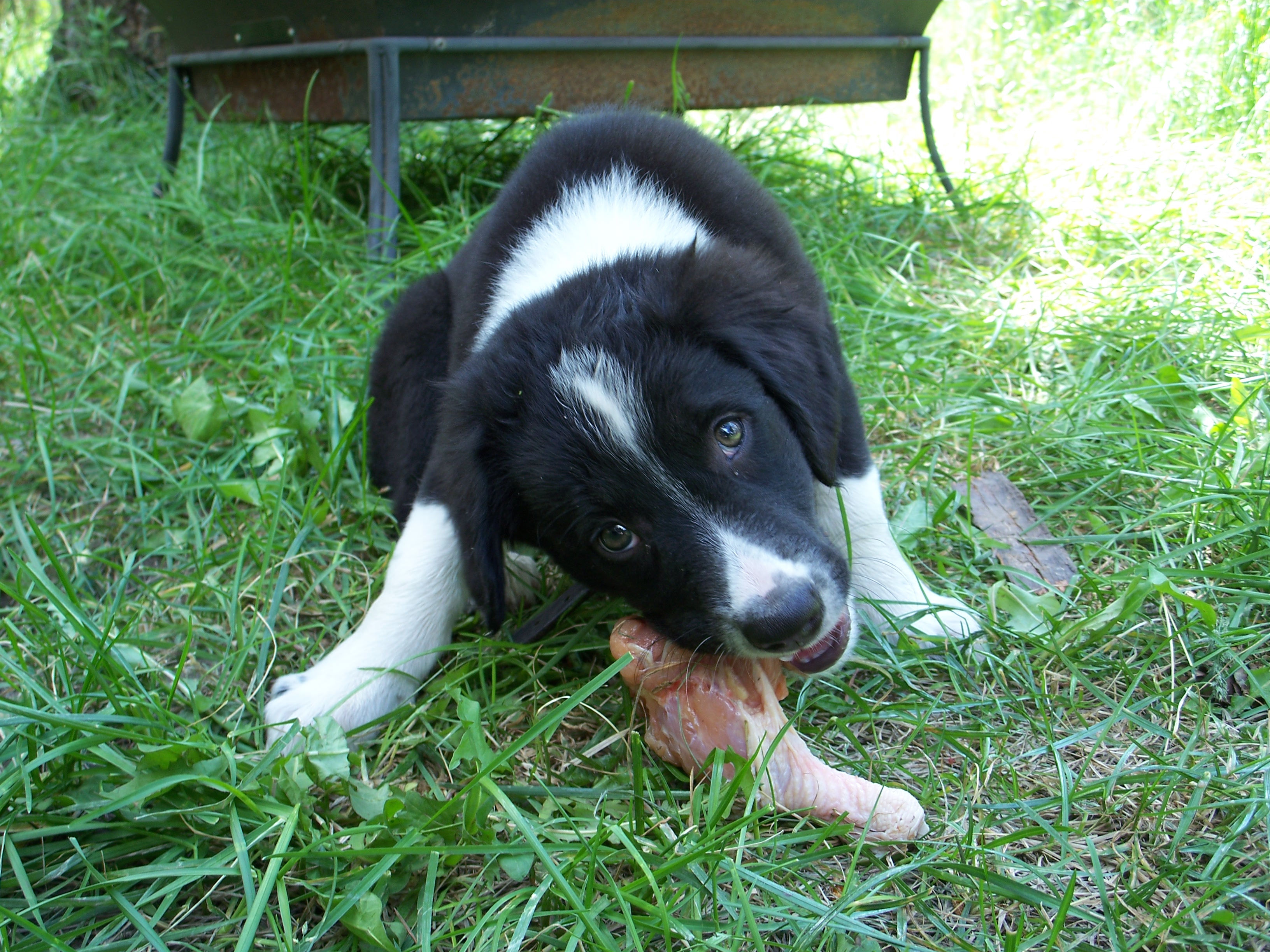
For Greer at 8-1/2 weeks of age, it was a natural to switch to raw. And did she ever love it, thriving and growing like a weed! Ditto that for Liam when he came to us. Puppies switched to raw are amazing to watch as they learn to eat meat with bone. Even our cats are raw fed. (Cats are an entirely different animal to raw feed and transition. Email Krystal if you are contemplating raw for your kitty.)
People say that raw fed dogs grow a bit more slowly. One thing’s for sure: they grow healthier! We’ve noticed that our pups are more balanced through each growth phase, looking much like miniature adults.
So, what exactly do we feed our carnivores? They get a wide variety of human-grade raw meat with bones – fish, chicken, beef, rabbit, pork, goat, sheep, wild game – much of it in its whole form or chunks large enough to really gnaw on and keep their teeth clean – organs, whole raw eggs, and raw milk. There are key supplements as well. Our pets get a good variety of healthy organs, meat, and bones for a naturally well-rounded diet. Yes, they eat very well!
They also enjoy occasional beef and buffalo bones as a recreational treat. Never rawhide though, which can block up their systems and become a choking hazard.
* We came to learn that Eoin’s increased symptoms directly correlated with the combo puppy vaccine given the week before onset; at the same time he also received a rabies vaccine and was micro-chipped. His system was stressed and overloaded with toxins. For more information on the dangers of vaccines, please visit our Canine Health and Research pages.
What Is It?
A biologically or Species-Appropriate Raw diet is one based on the physiological needs of any given animal. For our discussion here, we are talking about canines.
Dogs are scientifically recognized as ‘facultative carnivores,’ meaning they are largely carnivorous, while having the ability to digest small amounts of plant matter. To thrive and not simply survive, they need primarily meat, organs, and bones. According to the Smithsonian Institute, dogs are categorized as Canus lupus familiaris based on DNA testing that confirms domestic dogs are more closely related to the Grey Wolf, Canus lupus, than previously realized.
The canine digestive system cannot truly digest grains such as corn, rice, and wheat because they don’t produce the enzyme Amylase in their saliva, which is specific to the digestion of carbohydrates. Along with putrefaction, an overabundance of yeast can establish itself in a dog’s digestive tract due to these ingredients, causing bloating and discomfort at the very least, but they also contribute to dis-ease as well as both internal and external parasites.
Commercial dog food manufacturers use grain as fillers to help the dog feel full. They are less expensive than high-quality protein sources, so it helps keep their production costs down. Eating foods high in fillers means more to be eliminated as unused waste. This, in turn, means lots of stinky piles to clean up.
Take a close look at your dog’s teeth. Their teeth and jaws were designed for ripping and tearing, not chewing and grinding like the flat molars of humans. The teeth are all pointed or jagged to shear, cut through, and nibble-off meat; and their jaws are hinged to crush bone and swallow large pieces of meat. Although some do feed their dogs ground meat, it’s not quite biologically appropriate and can disrupt digestion. We feed whole pieces, with bone in. This is where it comes into play that they are benefited mentally. To see your dog truly enjoying his food, perhaps for the first time in his life like our Eóin, the look of contentment on his face, is a beautiful thing!
Feeding a raw diet does take a bit of extra time and forethought. By feeding your dog only natural foods that are biologically active and species-appropriate, his internal and external body condition is increased. The likelihood of him developing dis-ease is greatly reduced. Visits to the veterinarian due to problems are all but eliminated. We do recommend having an allopathic veterinarian on your dog’s health care team – who knows when he’ll need stitches or break a bone.
When you choose to feed a raw diet, your dog will be vastly healthier and happier!
Benefits
- Improved quality and length of life due to greater health
- Improves mental and physical well-being
- Stronger immune function, less money spent treating dis-ease
- Sparkling white teeth, healthy gums, fresher breath
- Organ health reduces incidence of chronic dis-ease
- Fewer, small stools with little or no odor
- Shiny coats with less shedding and body odor
- Eliminates/reduces skin allergies
- Full control over preservatives and chemicals
- Ideal for weight management
- Balances energy
- Live enzymes in real food enhance digestion
- Natural vitamins and minerals in fresh foods are bioavailable
- Fewer parasites; parasites do not thrive on or in healthy animals
Raw Basics
There are no absolutes to feeding your dog raw. It’s highly adjustable according to your dog’s needs – a little more bone, more meat than bone, more/less based on activity, etc. After you’ve been feeding raw for a couple weeks, you’ll get to know your dog’s needs. Here is a basic formula to follow as a starting point:
- 50% Raw Meaty Bones – meat with edible bones like fish, poultry necks, backs, wings, legs, thighs, etc.
- 40% Muscle Meat – meat without bones- heart, roasts, etc.
- 5-10% Organ Meat – liver, lung, raw green tripe, etc.
- Miscellaneous – whole raw eggs, raw milk
It is important to monitor your dog’s body condition to adjust amounts, more or less, depending on how he feels in the ‘hug test’. Also, adjust amounts according to his activity level. Sometimes a little more is needed to keep warm in winter; conversely, in the heat of summer the appetite can diminish. Here’s a handy calculator to aid in determining how much to feed your dog.
Remember to supply a nice variety. Every meal does not have to be completely balanced… balance is achieved over time. So go ahead and give your dog chicken three days in a row, red meat for a couple of days, and then lamb to round out the week. Each type of meat contains different nutrients and amino acids, so this variety will give him superior nutrition.
You Can Do It!
Depending on your dog, you can either switch over 100% immediately, or transition gradually. Paying attention to how your dog’s body responds will be the main determining factor.
Some dogs may experience soft stools the first couple of days. For this, simply give him 1-2 teaspoons of powdered slippery elm herb each day until it firms up again.
Try to keep the diet simple to begin with, starting with one type of meat for a few days, adding another type, and so on. Feeding meat with smaller bones or in 2 small meals will help your dog adjust to the new exercise his jaws and neck are receiving. Trim off excess fat and hold off on giving him any of the “Miscellaneous” items until it seems his system has fully adjusted, perhaps 2 weeks or so.
There may be a day here and there that your dog doesn’t want to eat. That’s okay! Wild canines go for almost a week without food. Some folks practice a Fast Day for their dogs each week, only making water available. Or a semi-fast day consisting of raw milk and whole eggs if the dog acts too hungry to fast completely. Our dogs enjoyed this special meal when we first started fasting them, and we witnessed the powerful cleansing benefits.
One thing to definitely be aware of – dogs not accustomed to eating raw meat and bones can sometimes choke. Their jaw, facial, and esophageal muscles aren’t used to it. They seem to eat faster in general on raw; most of the time our dogs finish eating in under 2 minutes. I do wonder whether a dog thinks his incredibly delicious new food may be one he’s not ‘supposed’ to have, so he scarfs it down even faster before it’s taken away! Just watch him for the first week especially, while he eats. Trust me, it’s not like you’ll have to stand and watch for a very long time.
You can also teach your dog to slow down by hand feeding – have your dog “sit and stay”, then hold the chunk of meat while he eats. He will eat slowly and carefully with you holding it. Once you see him slow down, go ahead and let go of the meat. It only took a couple times for Eóin and Greer to learn with this method.
In your dog’s enthusiasm to eat the tempting morsel you offer, he may accidentally nip your hand. We find it extremely helpful to train our dogs to “sit” or “down” and “stay” while we place their dish on the ground, then give the release command “okay, go eat”. This routine comes in handy for a pet sitter, too.
Some older dogs especially may not take to raw at first. Go even slower; do what you can. Be patient. Above all, keep at it! Every little bit is one step closer to a healthier dog.
Senior dogs also have higher nutritional needs, as well as an increased demand for organs. Email Krystal for help.
Keep in mind that a raw fed puppy develops very strong jaws and teeth. Translation: they can tear up furniture and toys in a flash. We liked the rubber puppy Kong for Eóin and so got one for Greer. Needless to say, we were quite surprised to see chunks taken out of it. Caution and supervision are in order.
Location, Location
Eating raw meat is a somewhat messy affair, and even more so for some dogs. Unless you don’t mind thoroughly sanitizing your floor after every feeding, go ahead and feed your dog in the house. You could train him to eat his meals on a sheet or large towel that is easily washed. I’m all about simplicity, so it’s outside on the porch for our dogs.
While living in the suburbs, we tried to be considerate of our neighbors. Observing a dog through the fence gnawing on animal parts could draw the unwanted concern of a neighbor. So, we opted to train our dogs to take their pieces of meat from a dish, in one location, instead of strewn all around the yard, as they sometimes do. It’s a helpful practice while traveling, too.
This does not mean, however, that we didn’t find the odd bone buried here and there, or see the neighbor dog gaze longingly as ours relished a big bone, but we could all live with that!
Whether you go cold turkey or gradually transition, by all means do give raw feeding your dog a try. We haven’t regretted it for an instant and will never go back!