
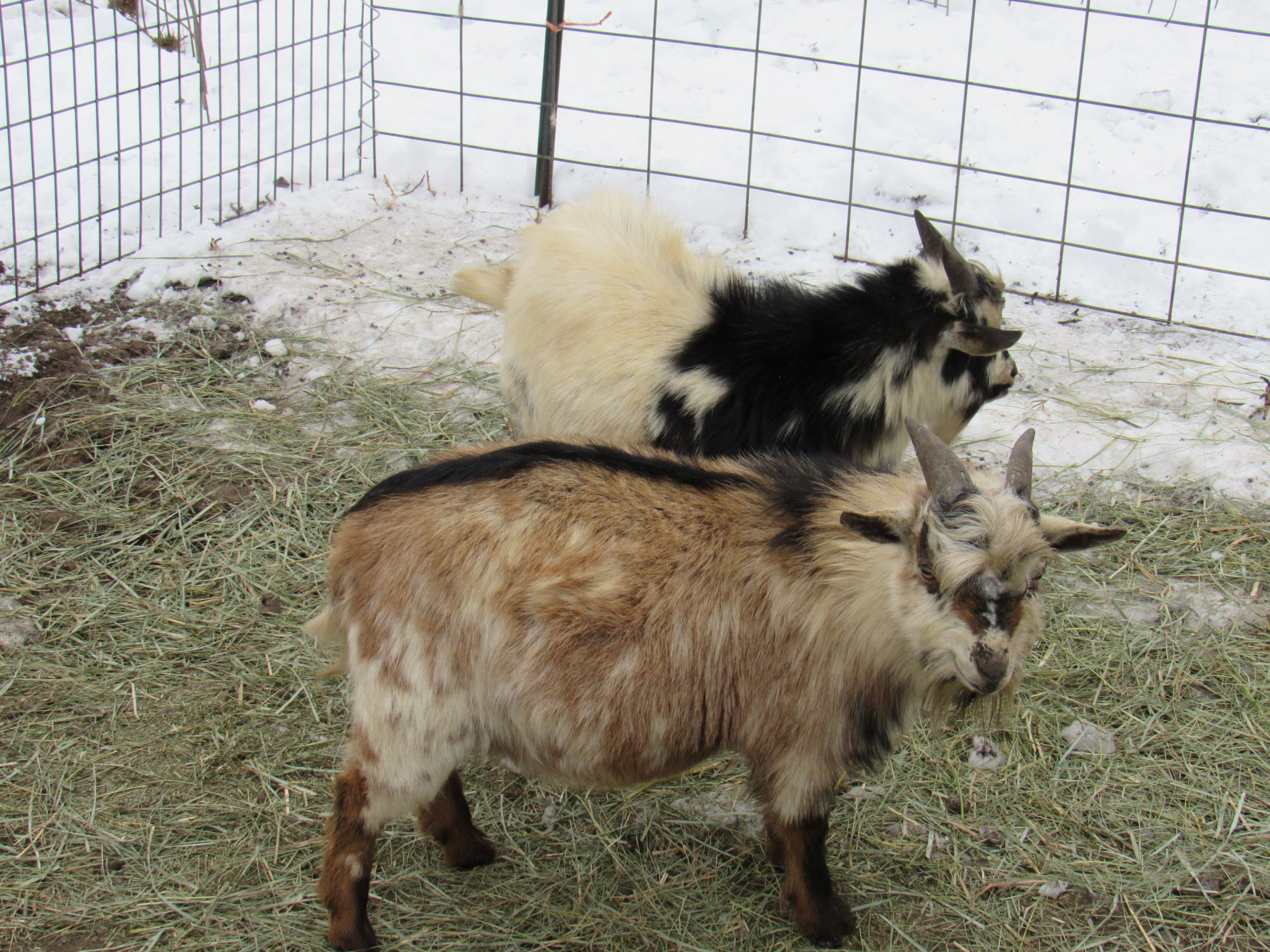
As with many breeds of livestock, the history of the Nigerian Dwarf is incomplete. In the 1980’s the Nigerian Dwarf goat was considered “rare” by The Livestock Conservancy. In 2013, the breed graduated from its list and is thriving. A conservation success story!
Throughout tropical Western Africa, there is a type of goat referred to as the West African Dwarf (WAD). These naturally small goats are used as a food source, meat, and milk, for the local population. In the writings about Albert Schweitzer’s work at his hospital in the country now known as Gabon, the local WAD goat is often mentioned as supplying milk for the hospital. Pictures of goats similar in type to Nigerian Dwarfs in the U.S. can be found.
As early as 1918, Joseph Crepin reported that WAD goats had been imported. There were also several documented importations from the 1930s to the 1960s. Basically, the first small goats in the United States were part of zoo exhibits. As their population grew, individuals were allowed to own some of these unique goats.
As time went on, breeders began to notice two distinct types: a shorter-legged, heavier-bodied animal typical of what is today known as the Pygmy breed; and the more refined, angular ones that have become today’s Nigerian Dwarf.
Early on, breeders attempted to keep each color line separate, the majority being brown, black or gold, all with or without random white markings; then breeders did begin to mix the color lines.
The International Dairy Goat Registry (IDGR) opened a separate herdbook for the breed, complete with a standard emphasizing dairy characteristics, on July 24, 1981. In 2002, the Nigerian Dwarf was accepted into the American Dairy Goat Association (ADGA) herdbook and is the only miniature dairy goat breed registered by them.
All breeds begin somewhere, but more important is where they go. Breeders continue to mold the breed into a superior milk-producing animal of unmistakable dairy type that happens to be small.
Indeed, the breed’s production qualities, versatility, resilience, compact size, and friendly and gentle disposition appeal to just about anyone, so their popularity continues to grow!
Nigerian Dwarf Traits-at-a-Glance
Small Size- One of the smallest goat breeds; well-suited for small spaces and easy handling.
Compact Build- A stocky, muscular build with a proportionate body supports efficient milk production.
Hardiness– Excellent foragers; adaptable; thrive in any climate, maintaining good health and production.
Disposition– Gentle, intelligent, friendly, curious, playful, affectionate.
Prolific– Twins most common, up to quintuplets; breed year-round.
Milk Production– High-quality; large volume in some lines; long lactation; high butterfat, excellent for cheese/butter production.
Versatility– Pets, milk, meat, brush eaters, show.
Distinctive Coat Colors & Patterns – Wide range of colors and markings gives each a unique and charming appearance.