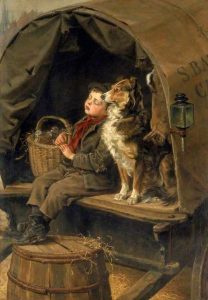
The English Shepherd is the American original, all-purpose family farmdog. Calm and steady, it has descended with its brain intact down through the generations. They are energetic and athletic yet gentle, noted for their good judgment. English Shepherds love their people, are a natural combination with children, and are wonderful companions for all ages. They are practical working partners in homes where their intelligence, spirit, and zest for life are understood and appreciated.
Are you looking for that old-style farmdog to help with chores on the homestead, keep varmints out of the henhouse and deer out of the garden, hold the hogs at bay yet tenderly watch over the children, a constant companion content to curl up at your feet at the end of the day? Then an English Shepherd just might be right for you.
An Ancient Breed
The English Shepherd dog is an ancient dog breed, one of the oldest in the world. According to legend, the English Shepherd is almost pure Roman sheep and cattle dog, originally brought to the British Isles by Caesar when he invaded in 55 BC. He used these dogs to herd the livestock brought along to feed his troops. As the livestock was depleted, extra dogs were left along the way and interbred with existing types of dogs with similar “herding” talents to intensify those instincts. These dogs became part of the Great Britain Highland herding dog tradition.
Long ago in the British Isles, shepherds wandered with their flocks over extensive open range. Exposed to the elements, wild animals, and thieves alike, the shepherd and his flocks’ lives depended on the intelligence and skill of his ever-faithful, vigilant dog, then known as Shepherd’s Dogs. English Shepherds today are descendants of the Shepherds’ Dogs of Scotland and Northern England, bearing a resemblance to that genetic group, both physically and in spirit. These larger shepherds with the “loose eye” were called Farm Shepherds or Shepherd’s Dogs.
American Roots
The first English settlers in the American colonies brought with them the finest Shepherd’s Dogs, and followed the development of the United States from east to west. It was here in America that they were given the name “English Shepherd”. Most long-haired working breeds carry English Shepherd blood.
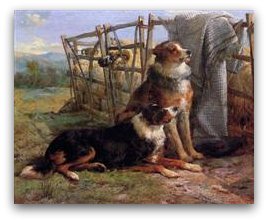
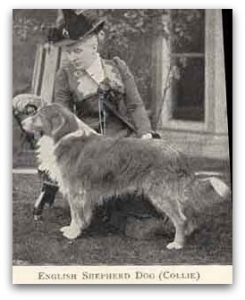
For generations, English Shepherds have been bred for all-around abilities, useful on a small to large farm. These range from herding and protecting livestock to vermin control, to companion and guardian of the home and family. The English Shepherd is considered a landrace American dog. Photographic evidence of these dogs dates back to the 1800’s.
As American life moved away from the family homestead to urban living, the need for this type of dog decreased. Elitism entered the story as show Collies were being bred for a more refined appearance with a longer, narrower head. The working dog bred for the needs of the area it served began to be viewed as a mongrel. Their numbers started to diminish.
About 1950, the common Farm Shepherd was being replaced by the increasingly popular Border Collies and Australian Shepherds. Then, exotic breeds were imported and became popular as pets. The decline coincided with the formation of kennel club registries and modern ideas of “pure” breeds.
Fortunately, a registry was formed around this time to protect the landrace English Shepherd breed. The United Kennel Club (UKC) recognized the English Shepherd in 1927 and holds an extensive registry of dogs. The national English Shepherd Club (ESC) maintains a breed registry and database as well.
The versatile English Shepherd has continued to work on farms, yet many dog fanciers are not familiar with the breed. This is changing as English Shepherds are excelling in competitive dog sports such as Agility, Flyball, Tracking and Obedience Trials, also as Service Dogs and in Search & Rescue.
The English Shepherd is worthy of praise and recognition as a multi-talented National Treasure!
“There are several other types of Collie’s quite distinct… in that they are “loose-eyed” workers… They are a easy going, level headed dog, useful but not flashy workers… For all around farm work they were often far more useful than the classically bred (trial type) dog.” – John Holmes in The Farmer’s Dog, 1960.
A Unique Spirit
The English Shepherd is highly intelligent and relatively easy to teach. Eager to learn, the more you teach, the more they desire! It is said they are capable of learning 300 words and possess the intellect of a 3-year-old child. Accompanying his master in daily chores, the English Shepherd learns the order and routine, and then develops the desire and ability to maintain that order.
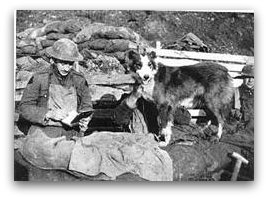
Unequaled as companions, the English Shepherd is easygoing and loves affection, developing a close bond with his master. Stories abound across the generations of astonishing acts of devotion. Fortunate is the child who grows up with an English Shepherd as his best friend! During both world wars of the twentieth century, English Shepherds were used as mascots and couriers, often dodging bullets, proof of their stamina, grit, and devotion.
An English Shepherd possesses a unique spirit. Treat him mean, and it will hurt his feelings, but with just one kind word, he comes running; all is forgiven. Calm in disposition, he often forms a nurturing bond with the master’s livestock, exerting a calming influence on them in turn.
Intensely loyal. Affectionate. Desiring to please. Ever aware. These are the hallmarks of the amazing English Shepherd!
Difference Between Other Herding Breeds
An informative page highlighting the differences between the English Shepherd, Border Collie and Australian Shepherd.